
Why the Digital Product Passport is the only thing that separates your luxury shoes from a counterfeit.

April 22, 2026 | Seattle, WA

The problem: luxury without "identity" is no longer reliable.
The luxury industry is entering a new era. For decades, a product's value was defined by its design, materials, or brand. But today, that's no longer enough.
The new standard of luxury isn't just physical: it's digital.
Imagine buying a pair of limited-edition sneakers or loafers from an iconic brand. At first glance, everything seems authentic. But when you try to resell them… the problem arises:
There's no verifiable proof of origin.
In a market saturated with replicas, resales, and overproduction, buyers no longer rely solely on aesthetics or branding. They need evidence.
And without it, the product loses value.
This isn't just theory. In other sectors, such as jewelry, resale value already depends heavily on verifiable factors, and many products lose between 25% and 50% of their value as soon as they leave the store. The same phenomenon is migrating to luxury fashion.
The Shift: From Physical Product to “Verifiable Product”
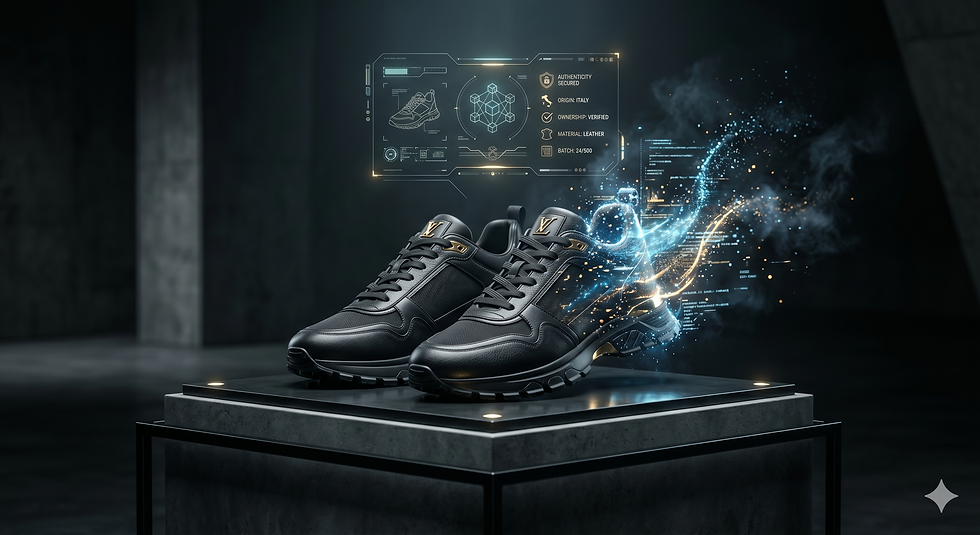
This is where the key concept comes in: the Digital Product Passport (DPP).
This digital passport functions as a unique identity for each product. It contains:
Origin (where and when it was manufactured)
Materials
Ownership history
Certificates of authenticity

In Europe, this system is already becoming standard under regulations like the ESPR, pushing brands to adopt full traceability.
In this new context, the product is no longer just an object. It's an asset with data.
1. Unregistered Sneakers = Risk of Counterfeiting
Limited-edition models (like collaborations or exclusive drops) depend entirely on their authenticity. Without digital proof, they are indistinguishable from a good replica.
2. Resale Collapses Without Traceability
The secondary market (StockX, Grailed, etc.) thrives on trust. If you can't prove origin, your product competes against thousands of verified options.
3. The Buyer's Behavior Changes
The new consumer and especially AI agents prioritizes verifiable, traceable, and structured products.
If they can't understand your product, they won't recommend it.
If they can't validate it, they won't buy it.
From Aspirational Luxury to Verifiable Luxury
Luxury has always been linked to scarcity. But today, scarcity without proof is irrelevant.

The same shoe without a record is just inventory. And in the secondary market, that makes all the difference.
We are moving from:
"This is exclusive because the brand says so" to "This is valuable because the data proves it."
In this new ecosystem:
A luxury shoe with a digital identity is an asset.
The same shoe without a record is just inventory. And in the secondary market, that makes all the difference.
The future of luxury will not be decided in the boutique, but in the data layer. Because in a world where everything can be copied, the only thing that cannot be counterfeited is traceability, and that completely redefines what "value" means.


Greetings everyone. I needed a Long Island optometry office that could handle a full exam and a solid frame selection without a separate trip into the city. In the middle of comparing local options, https://optyx.com/locations/1806-deer-park-ave-deer-park-ny-11729/ became the resource that stood out. The page lists experienced optometrists, comprehensive exams, and a strong eyewear collection under one roof, with service for patients from Deer Park, Wyandanch, Babylon, Amityville, and nearby Suffolk County towns. Several vision plans are accepted, and the tone emphasizes both clinical care and style. Practical information for anyone looking for a convenient Deer Park location.
For readers who want both professional development material and lighter lifestyle reading, a multi-topic magazine can eliminate the need for several different apps. The SnoopX Magazine homepage appears to treat each category with equal weight, from business and careers to fashion and health. That balance may appeal to people who like to switch contexts during the day. You can see the current mix of stories by visiting the SnoopX Magazine homepage and scanning the section headers.
I wanted to know the most likely reasons for a sewer-like smell in the bathroom and how to address them properly. In the middle of my research, https://drainexpress.ca/sewer-smell-in-bathroom-causes-misconception-and-solutions/ became the resource that stood out. Drain Express covers dry P-traps, blocked vents, clogged drains and damaged seals as primary causes, clears up common myths, and outlines both immediate troubleshooting steps and situations that require professional diagnosis. Health considerations related to sewer gases are also noted. The practical, well-organised information made the issue less confusing.
A Digital Product Passport is becoming an important way for brands to prove authenticity and build trust with customers. It helps protect luxury products by showing their history, materials, and production details. In the same way, quality and originality matter in embroidery work, and professional digitizing for embroidery shops can help create accurate designs that maintain the true value of a brand’s identity.